

Right to Work Changes from 1st October 2026: What Employers Need to Know.
30 Sept, 20262-minutes

If you use temporary, agency or contract workers, there are important changes to the UK Right to Work scheme coming into force from 1 October 2026.
The changes expand the statutory Right to Work scheme beyond traditional employees to cover a wider range of working arrangements, including workers engaged under worker contracts, individual subcontractors and certain online matching services.
One of the areas causing the most confusion is extended liability.
What is extended liability?
Currently, the business that has the direct contractual relationship with the worker is generally responsible for carrying out the prescribed Right to Work check.
From 1 October 2026, in certain contractual arrangements, liability for illegal working may extend further up a contractual chain.
This can potentially apply where a business is contracted to provide work or services to another party and then engages another employer or supplier to provide workers to fulfil that contract.
However, this does not mean every client using agency workers suddenly becomes responsible for carrying out duplicate Right to Work checks.
What about normal agency workers?
The Home Office guidance specifically recognises that the normal supply of agency or temporary workers will not ordinarily fall within the extended liability provisions where an employment business is simply supplying workers directly to a hirer and is not contracted to deliver the underlying work or service.
Put simply:
Recruitment agency supplies a temp → client manages the agency worker and the work → normal agency supply → extended liability would not ordinarily apply.
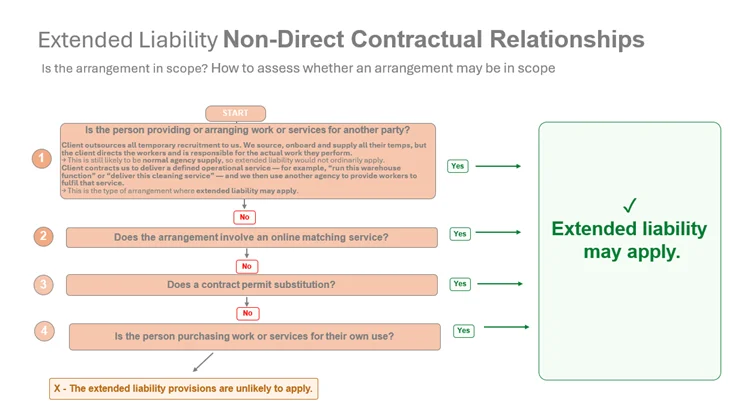
For example, a client may outsource all its temporary recruitment to an agency. The agency sources, onboards and supplies the workers, but the client manages those workers and remains responsible for the work they perform. This remains normal labour supply.
The position can be different where a business has taken responsibility for delivering an actual service.
For example:
Client contracts Company A to deliver a warehouse operation → Company A uses another agency or employer to provide workers to deliver that service → extended liability may apply.
Below is a useful flow chart to understand if an arrangement is in scope for extended liability
What happens if extended liability applies?
The Home Office will generally first look for the employer that has the direct contractual relationship with the worker.
That employer remains responsible for carrying out the prescribed Right to Work check.
If that employer cannot be located, or where the extended liability provisions apply, the Home Office may consider whether another party within the contractual chain is liable.
The below flow chart helps explain this -
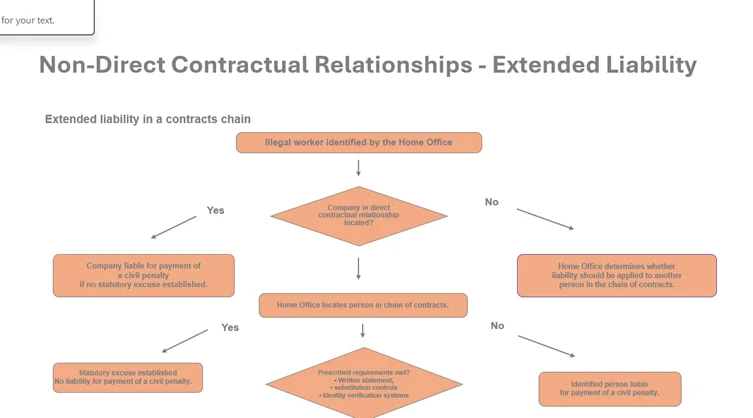
The key point is that extended liability is aimed at contractual and subcontracting arrangements — it is not a blanket transfer of Right to Work responsibility to every end client using temporary workers.
What does this mean if you partner with MCS?
At MCS, I oversee a robust Right to Work process for every agency worker we supply.
This includes checking eligibility before an assignment starts, retaining the appropriate evidence and completing follow-up checks where required.
Right to Work compliance is therefore built into our temporary worker onboarding process, reducing the risk.
For clients using MCS through a normal agency supply arrangement, you can be reassured that we take our responsibility for Right to Work compliance seriously.
The main area businesses should consider ahead of 1 October 2026 is whether they have any more complex subcontracting, service-delivery or substitution arrangements that could bring them within the new extended liability provisions.
The key message is simple: understand how your workforce is engaged, know where responsibility sits and make sure your supply chain arrangements are compliant.
If you're unsure how the changes could affect your temporary workforce or existing recruitment arrangements, speak to MCS, and we can help you understand what the changes mean in practice.